


Industrial Racking Systems for South African Warehouses
Industrial racking is how warehouses store more without building more.
Heavy-duty steel uprights and beams let you stack palletised goods vertically, turning unused ceiling height into productive storage.
Spode Storage Solutions designs and installs the full range of industrial racking systems for warehouses across South Africa. Every system is matched to your floor space, load weights, and forklift equipment.Not sure which system fits your operation? Our team visits your site, assesses your space, and recommends the right solution.
Request Site Assessment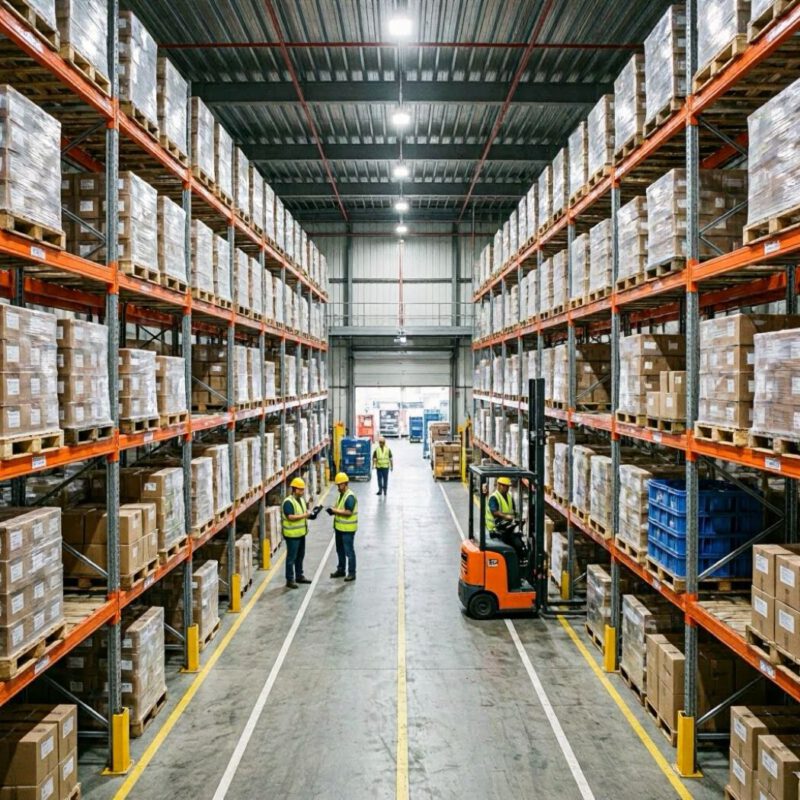
Types of Industrial Racking Systems
Different warehouses need different racking. The right choice depends on what you store, how you move it, and how often you need to access it. Here is how each system works.
Racking Systems We Supply
Every operation stores products differently. That’s why industrial racking should never be one-size-fits-all. Below are the most common systems we design and install, often combined into hybrid layouts.
Selective Pallet Racking
Selective pallet racking is the most widely used warehouse storage system in South Africa. Every pallet sits in its own bay with direct aisle access. You can pick any pallet without moving another.
It suits operations with many SKUs, frequent order picking, and FIFO stock rotation. Spode selective racking reaches up to 11 metres high and adjusts in 50mm beam increments. It works with counterbalance trucks, reach trucks, and VNA turret trucks.
Best for:- General warehousing and distribution
- FMCG and retail
- Cold storage with multiple product lines
- Manufacturing finished goods
Drive-In and Drive-Through Racking
Drive-in racking eliminates the aisle between every row. Pallets are stored multiple positions deep on rails inside the rack. Forklifts drive into the lane to load and retrieve.
This gives you significantly more pallet positions in the same floor area. Drive-in operates on LIFO (last in, first out). Drive-through racking adds access from both ends, enabling FIFO rotation for date-sensitive stock.
Best for:- Cold storage and freezer facilities
- Bulk stock with few SKUs
- High-volume uniform product lines
Push-Back Racking
Push-back racking stores two to six pallets deep per lane on rolling carts and inclined rails. Loading a new pallet from the aisle pushes the previous one back. Unloading reverses this: the pallet behind rolls forward to the pick face.
Forklifts never enter the rack. Push-back operates on LIFO and gives you more density than selective racking with less aisle sacrifice than drive-in. It is a practical middle ground for medium-turnover stock.
Best for:- Retail distribution centres
- 3PL warehouses with multiple pallets per SKU
- Consumer goods and manufacturing overflow stock
Carton Flow Racking
Carton flow racking uses gravity-fed roller or wheel tracks built into a selective racking structure. Stock loads from the back of each lane. Gravity brings it forward to the pick face. The carton that went in first comes out first.
It is a FIFO system designed for hand-picked individual cartons and cases, not pallets. Pickers work from the front face only. Replenishment happens from the rear, keeping the two operations separate and efficient. It is commonly combined with selective pallet racking in the same bay.
Best for:- Pick-and-pack operations and e-commerce fulfilment
- FMCG and food distribution with date-sensitive carton stock
- High-frequency order picking with many SKUs
- Retail distribution centres needing fast replenishment
Cantilever Racking
Cantilever racking stores long, bulky, or irregular stock that will not sit on a standard pallet rack. Horizontal arms extend from a central column with no front upright in the way. Items of any length load without obstruction.
Available in single-sided (against a wall) and double-sided (freestanding) configurations. Arms adjust to different heights and come in various lengths and load ratings.
Best for:- Timber yards and steel suppliers
- PVC pipe and metal rod storage
- Furniture warehouses
- Construction material depots
Mezzanine Floors and Multi-Tier Racking
When you need more space but cannot build out, build up. Spode designs rack-supported mezzanine structures that add a full working level above your existing floor.
Multi-tier racking with integrated stairways doubles or triples your usable storage area without touching the building structure. Ideal for slow-moving stock, archive storage, and pick-and-pack operations.
See our Mezzanine Floors pageIndustrial Racking vs Light-Duty Shelving
Not everything you store belongs on a pallet rack. Here is the practical difference.
Most warehouses use both. Spode supplies the full range. Our team will advise on which system fits each zone of your facility.
Racking Applications by Industry
Industrial racking systems are used across manufacturing, logistics, retail, and healthcare in South Africa. Each sector has specific requirements. Here is how we match the right system to each application.
Why South African Warehouses Choose Spode
Design and Consultation
We visit your site, measure your space, and design a racking layout around your floor plan, load weights, forklift type, and workflow. You get a custom plan built for your warehouse, not a generic template applied to it.
Supply of Quality Equipment
Every Spode racking system is manufactured from certified high-grade steel. We supply the full range: selective pallet racking, drive-in, push-back, carton flow, cantilever, mezzanine floors, and all accessories. One supplier for your whole project.
Professional Installation
Our installation crews handle assembly from the first bolt to the final safety check. Every system is anchored, levelled, and inspected before we hand over. We schedule work to minimise disruption to your operations.
Racking and Shelving Audits
Racking takes knocks. Regular inspections catch damage before it becomes a safety issue. Our team conducts full site audits and provides a written report with repair recommendations. We can replace damaged components and reconfigure your layout if your requirements change.
Branches in Johannesburg, Durban, and Cape Town
Spode operates from three South African branches.
Johannesburg
Woods Warehouse, Rand Airport Road, Gosforth Park, Germiston
+27 (11) 100 4772Durban
Endalini Building, 1 Wareing Road, Pinetown
+27 (31) 263 0055Cape Town
Kirstenhof, Cape Town
+27 (21) 773 0772We provide site visits, installation, and ongoing support across South Africa.
Industrial Racking FAQs
What is heavy-duty industrial racking?
Industrial racking is a heavy-duty steel storage system designed to hold palletised goods and other large items in a warehouse or factory. Uprights and beams form multiple storage levels that can support tonnes of stock per bay. Forklifts or pallet jacks load and retrieve goods at height. The result is a warehouse that uses its vertical space fully, keeps heavy stock off the floor, and stays organised under daily operational pressure.
What types of racking system do I need for my warehouse?
The right system depends on what you store, how you rotate stock, and how often you need to access each pallet. Selective pallet racking suits most operations because every pallet is directly accessible. If you store large quantities of the same product, drive-in or push-back racking increases your density. For FIFO rotation of individual cartons and cases, carton flow racking handles this automatically. Long or irregular items need cantilever racking. Many warehouses combine two or more systems. Our team can visit your site, assess your stock profile, and recommend the right mix.
How is heavy-duty racking different from light-duty shelving?
The key difference is load capacity and how goods are handled. Heavy-duty pallet racking is built for forklift-loaded palletised goods and can support tonnes per level. It uses thick steel components anchored to the floor and can reach heights of 11 metres or more. Light-duty shelving is built for hand-loaded items at human reach height. Each shelf typically handles tens or hundreds of kilograms. Both systems serve different zones of a warehouse. Putting heavy loads on light-duty shelving is a safety risk. Our team will confirm which system is appropriate for each section of your facility.
Can Spode design a custom racking layout for my warehouse?
Yes. Design and consultation are part of every Spode project. Our team can visit your warehouse or work from your floor plans. We measure the space, map your workflow, and design a racking layout that fits your ceiling height, aisle widths, forklift type, and stock profile. You receive a detailed plan before any equipment is ordered. There are no templates. Every layout is designed for your specific facility.
Do you provide installation and ongoing maintenance?
Yes. Spode handles full installation of all racking we supply. Our crews assemble, anchor, level, and safety-check every system before handover. We also offer ongoing support through our Racking and Shelving Audit service. Regular inspections catch damage early, before it becomes a safety or compliance problem. If we find issues, we can repair or replace components and help you reconfigure your layout as your operation changes.
How much weight can a heavy-duty racking system hold?
Load capacity depends on the upright frame size, beam depth, bay width, and configuration. Each Spode racking system is engineered for your specific load requirements. Every installation includes load rating signage on the racks that clearly states the maximum safe load per level and per bay. You should never exceed the rated capacity. If your load requirements change after installation, contact our team before making adjustments.
Are racking systems expandable if my storage needs grow?
Yes. Pallet racking is modular. You can add bays to an existing row as your operation grows, provided the new components are compatible with your existing system. Beam heights can be adjusted to accommodate different pallet sizes. Spode supplies compatible extension components for systems we have installed. If you are making significant changes to load weights or rack heights, we recommend a review by our team first to confirm the structure remains within rated limits.